


Birth
 When to Come to Hospital
Here is what you can do at home to cope with “early” labour pains (contractions):
- Have a shower or bath to help you relax
- Have your partner/friend rub your lower back during a contraction
- Try some deep slow breathing during a contraction
- Take a walk with your partner/friend
- Change positions often such as walk, sit, and lay down
- Have a light meal such as tea, soup and toast and drink fluids
- Empty your bladder (pee) often
- Try to nap or rest
- Watch TV or a movie
Come to the Obstetrical Triage unit if you:
- Think you are in active labour
- Contractions come about every 5 minutes for 1 hour
- Contractions last about 1 minute
- Contractions hurt so much that it is hard to speak or walk
- Are having bright red bleeding from your vagina
- Notice a decrease or change in your baby’s movements
- Cannot cope with your labour pains
- Think your waters are broken
- Or your health care provider advises you to come in
If at any time you have questions or concerns, please call your doctor, midwife or Health Links-Info Santé at 204-788-8200 or toll-free 1-888-315-9257.
Please note that as of January 2018, the Obstetrics, Gynecology & Neonatology Program has changed its model of care.
People will labour and deliver in one of two areas on the 3rd floor. After giving birth, they will be transferred with their new-born to another area on the same floor for the remainder of their stay in hospital.
With the exception of the change noted above, the information provided in the virtual tour videos below remains the same.
Are You in Labour?
What to Bring To Hospital
Preparing ahead of time is a good idea. Please bring the following:
- MB Health card, private insurance cards, SIN card
- Comfort items while you are in labour like lip balm, lotion, iPod, CD’s
- Slippers
- Nursing bra (2)
- Underwear
- Personal toiletries/items (shampoo, toothbrush & paste, deodorant, hair brush)
- Going home clothes (loose & comfortable)
- Baby Sleepers (3)
- Baby blanket
- Infant Car seat
Parking
- Pay parking is available 24 hours directing in front of the hospital
- Public parking is available across the street behind 400 Taché Ave. and in the hospital parkade across from the Emergency entrance
- Street meter parking is located on various city streets around the hospital
Allow time to find a parking spot, getting into the hospital and if required, returning to your meter in time.
Admission
Admissions for birth are in the Obstetrical Triage unit, located on the third floor of the main hospital, room E3004. The St. Boniface Hospital front entrance is located at 409 Taché Ave. (east side of main hospital) and is open 6am-9pm daily. If you arrive at a time outside these hours, please enter through the front entrance and press the security call button in the vestibule to gain entry.
In the Obstetrical Triage unit you and your baby will be assessed by a nurse, doctor or midwife to see if you are ready to be admitted. If not, you will be sent home with a plan for follow-up care.
What to Expect When You Arrive
Preferred Accommodation
The Postnatal Unit has 23 private, 2 semi-private rooms and one three-bed room; they are assigned on a first-come-first-serve basis, so you may not get your preferred accommodation right away. Booking rooms in advance is not available.
Where you will stay?
Support Person
Supportive Care in Labour
Medication Options
Epidural Anesthesia
Birth
Recovery and Postpartum
Labour and Delivery
Cesarean Section
Recovery and Post Partum
Neonatal Intensive Care Unit (NICU)
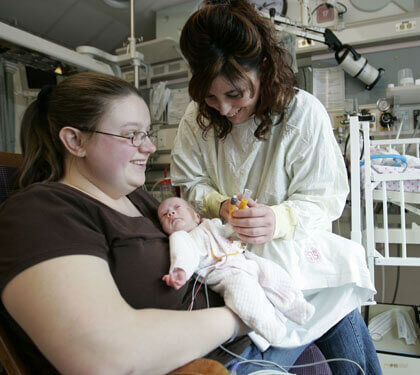
Parents are the most important people in a baby’s life. In NICU, we take care of the whole family, not just the baby. We will help you find support to meet your needs. Talk to your baby’s nurse about things that you are finding hard to deal with.
As a parents or guardians, you may visit at any time and spend as much time with your baby as you wish. You may phone at any time and as often as you need to (phone number 204-237-2775). We will only give information to parents or guardians.
The St. Boniface Hospital NICU cares for over 600 sick or premature babies each year. A helpful guide to use as a marker for going home is your baby’s due date. Most babies go home close to their due date; some will be ready sooner, and some will need to stay longer.
It will take time for you to get used to the equipment and strange sounds in NICU. We will tell you about your baby and their progress each time you phone or come in.
To learn more about the NICU, click below to read our parent information brochure: The Journey with your baby! Welcome to NICU.